A new Systemiq and INDEF GTI report shows how Renewable Energy Zones can unlock billions in investment, accelerate clean power deployment, and help Indonesia reach its 8% growth ambition, at the same time.
Indonesia stands at an inflection point. With an 8% economic growth target by 2030 and a landmark 100 GW solar commitment already in place, the conditions for a clean industrial revolution are taking shape. But ambition alone will not close the gap.
This report by Systemiq and the Institute for Development of Economics and Finance (INDEF) – Green Transition Initiative launched in Jakarta (on 28 April 2026), sets out how Renewable Energy Zones (REZs), purpose-designed clean energy clusters embedded within Indonesia’s industrial zones, can serve as the connective tissue between renewable energy supply and industrial demand. The analysis draws on modelling across eight Special Economic Zones as an example of the potential economic impact, as well as Indonesia’s broader industrial base to quantify the economic, energy, and emissions opportunity at stake.
Key Findings
- $13–18 billion in capital expenditure unlocked: When implemented across eight selected Special Economic Zones, REZs can attract $13.2–18.1 billion in new capital investment and add 24–32 TWh of renewable energy generation.
- Up to 100,000 additional jobs: Scaled across Indonesia’s wider industrial base, REZs could generate up to 100,000 new jobs, $17–26 billion in additional green growth, and 85–101 TWh of clean power generation.
- Cutting the time to build: Renewable energy project development in Indonesia currently takes an average of more than 48 months from origination to financial close. REZs can significantly accelerate procurement, land acquisition, and planning – compressing that timeline at scale.
- A direct path to emissions reduction: Shifting industrial electricity demand to clean sources yields substantial decarbonisation gains. At 40% renewable penetration, the modelling shows a reduction of over 2,000 MtCO2e – a 21% cut.
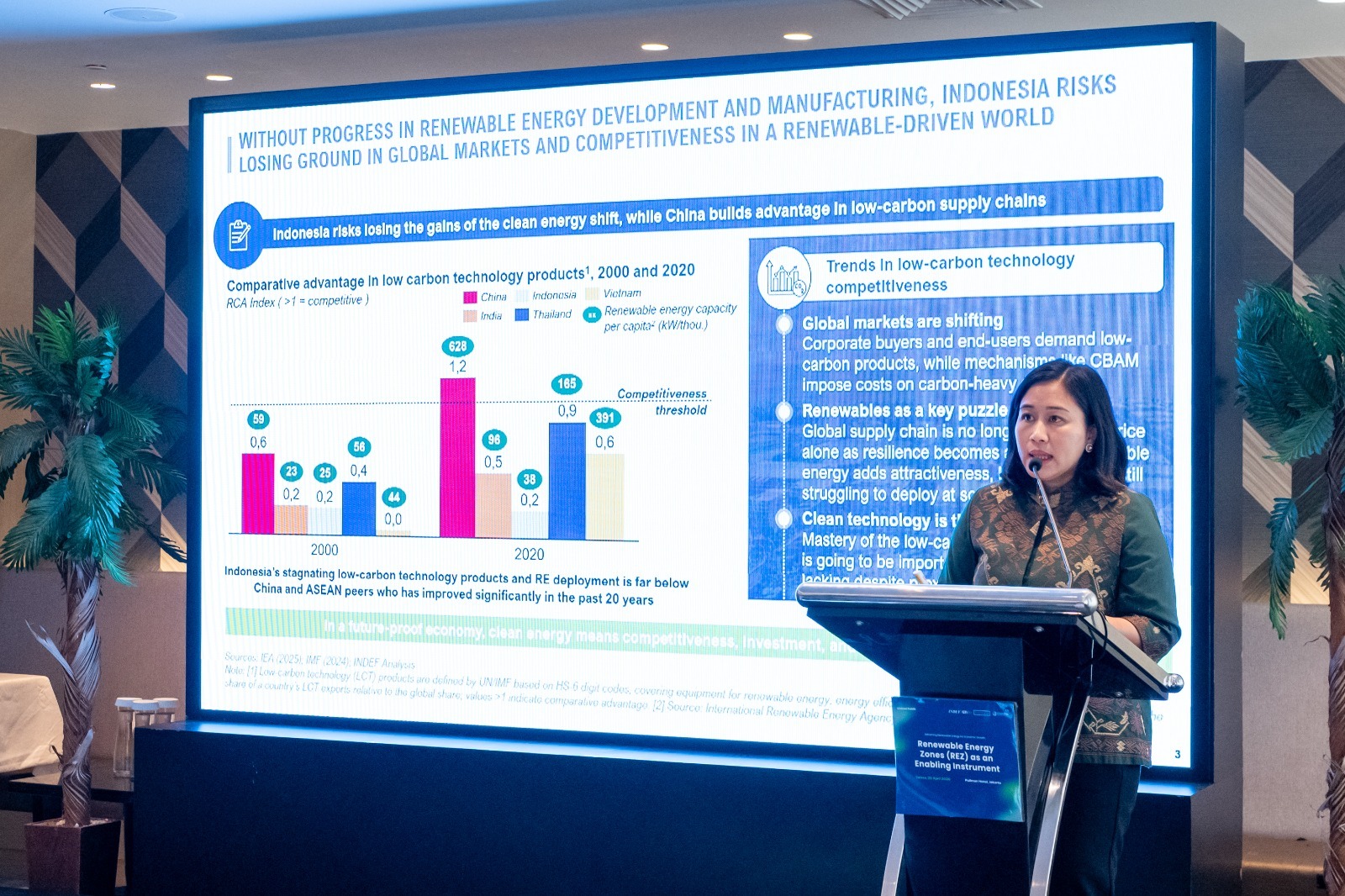
- Manufacturing competitiveness restored: Indonesia’s low-carbon technology competitiveness has stagnated, with an revealed comparative advantage (RCA) index score below 0.2, well short of the 1.0 threshold, and renewable deployment of just 38W per capita, compared to 628W in China and three times that level in Thailand. REZs create the conditions to reverse this trajectory.
Why this matters
Indonesia’s industrial base is being reshaped by a convergence of forces: the global shift toward electricity-intensive industries such as data centres, EV manufacturing, and metals processing; domestic demand for Solar PV and battery storage manufacturing; and the government’s own 100 GW solar programme, of which 15–45 GW is expected to come from industrial demand. REZs are not a future option, they are an immediate lever to connect these trends into coherent, investable programmes.
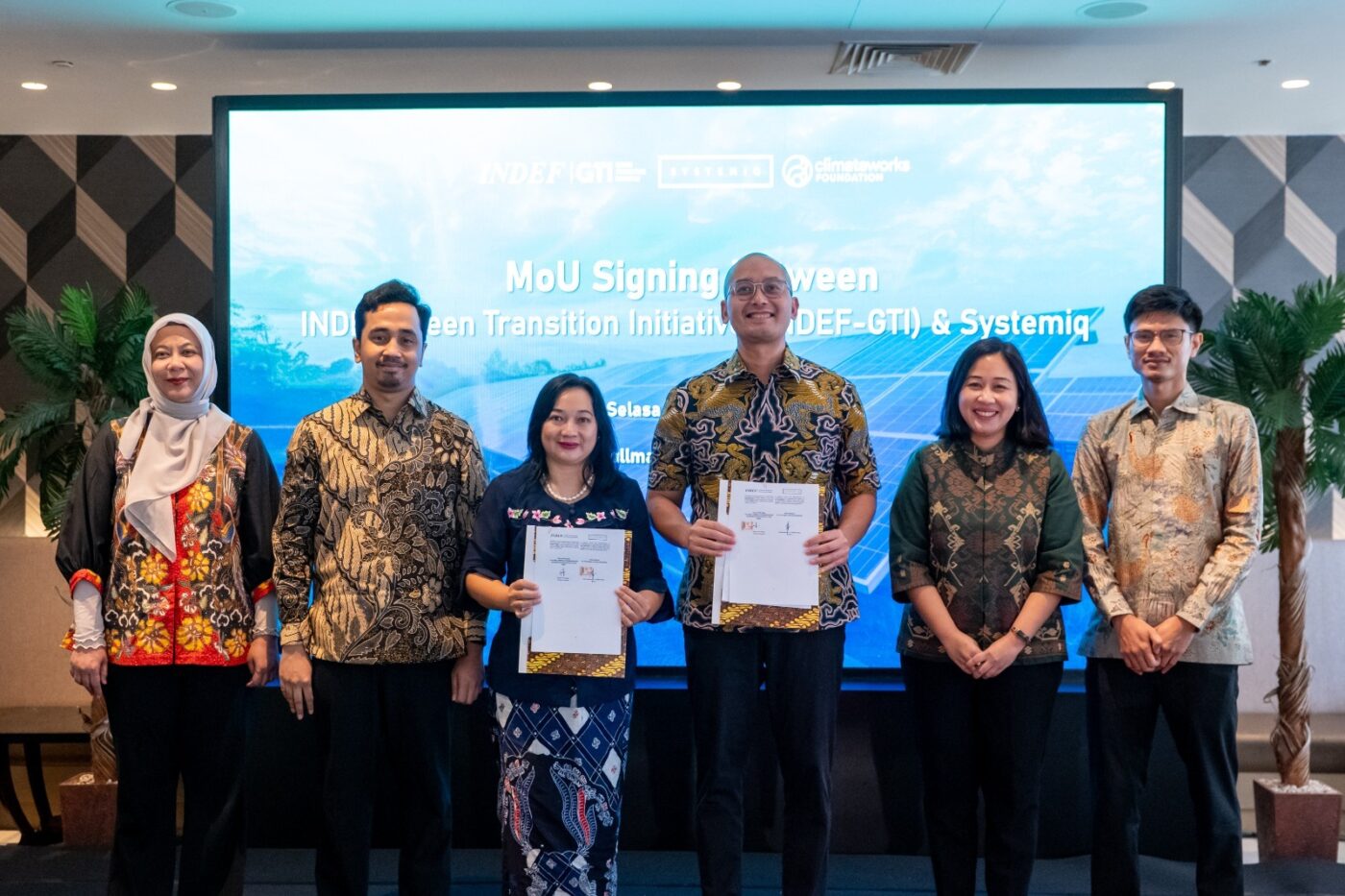
The report launched on 28 April 2026 at an event convened by the Institute for Development of Economics and Finance (INDEF) in Jakarta. On the occasion of the launch, Systemiq Indonesia and INDEF-GTI signed a Memorandum of Understanding to deepen collaboration on industrial decarbonisation and energy transition in Indonesia.