
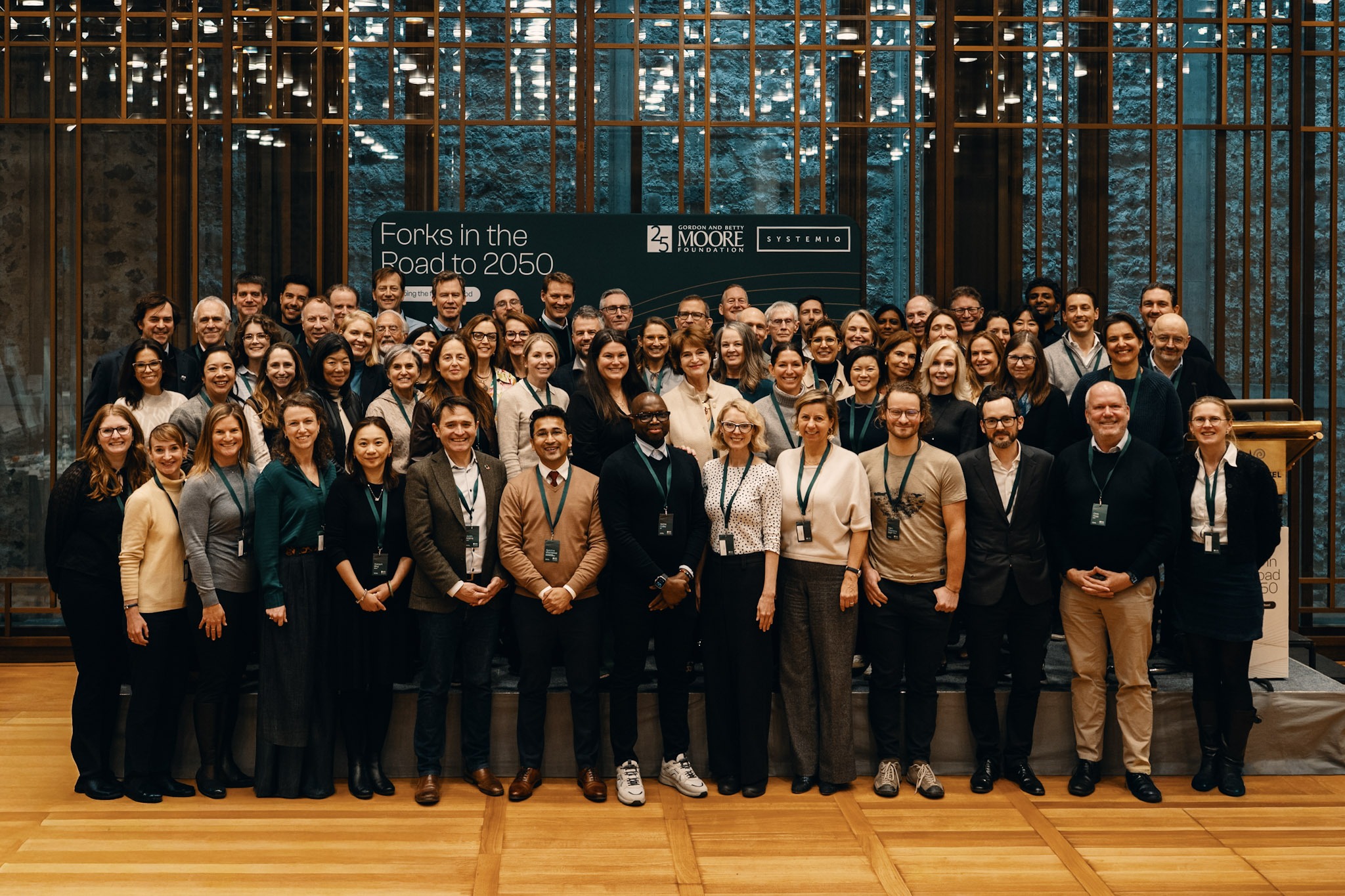
Systemiq co-hosted the Forks in the Road to 2050 Symposium with the Moore Foundation recently, bringing together 70 senior leaders from business, finance, civil society, multilateral institutions, philanthropy and academia for a candid, futures-focused discussion about our global food system. Held in Zurich, the symposium created space for participants to explore where the global food system is heading and what it will take to shift current trajectories.
Jeremy Oppenheim, Managing Partner at Systemiq, opened the symposium with a keynote which set the tone for the discussions that followed. He traced how the food system evolved into its current form, showed why incremental change is no longer enough, and set out three lessons for unlocking a transition that delivers health, resilience, nature and livelihoods together.
Read the full keynote below.
Forks in the road: Why food needs a new playbook

Jeremy Oppenheim doing the keynote at Forks in the Road to 2050 Symposium.
Photo credit: Steven Kohl
Opening: Setting the scene
Good afternoon, everyone. It’s a privilege to welcome such an extraordinary group of leaders to the Moore Foundation/Systemiq Future of Food Symposium.
This isn’t just another conference – it’s a working dialogue. Over the next 1.5 days, we have a rare, use-it-or-lose-it opportunity to challenge assumptions, sharpen our collective ambition, and push towards solutions that will not emerge unless we make the most of this moment.
Our task is to move beyond talk, to build the relationships that will make those solutions real, and to hold each other – and ourselves – accountable for outcomes. That’s the challenge I want to set for us, right from the start.
Provocation: The food system isn’t broken – it’s booming
Let me start with a provocation: the food system isn’t broken. It’s booming.
By the standards of its original mission – feeding billions cheaply and reliably – the food system has been a stunning success. It has delivered abundance at a scale unimaginable a century ago.
Think about this: in 1960, the average person consumed about 2,100 calories a day. Today, global averages are closer to 2,900 – even as we feed 5 billion more people, and lose or waste more than a quarter of the food we produce. That’s not failure; that’s overachievement.
Of course, the same system has devastating effects – inequality, obesity, climate risk, and biodiversity collapse. But if we only call it broken, we miss the genius of its design – and the clues for building something better. Understanding why the current system succeeded is essential to transforming it.
The rise, the stall and the swirl
So how did we get here, and what’s coming? Let’s canter through the story.
First, the rise. The Green Revolution was one of humanity’s greatest accomplishments. Science delivered abundance. Yields soared. Famines receded. Since 1960, global food production has tripled, driven largely by productivity gains in the Global South. As incomes rose and cities grew, demand for protein – especially meat – has soared, reshaping diets.
The era of convenience followed. Ultra-processed foods met the demands of urbanisation, rising incomes, and speed. Shelf‑stable, affordable food was modernity on a plate for billions. Today, more than half the calories in the US and UK come from these foods.
But then, the stall. Yield improvements are flatlining: global on-farm productivity growth is now less than half what it was a decade ago. To keep up with demand, we’ve pushed deeper into forests and grasslands, driving nature loss and mounting environmental costs: soil degradation, water stress, greenhouse gas emissions.
Health crises are deepening too: nearly 3 billion people are malnourished – 800 million hungry, 2 billion overweight or obese – and “invisible ingredients” such as excess salt, sugar, and chemical residues are contributing to rising rates of chronic disease.
At the same time, smallholders make up more than 80% of the world’s farmers yet produce only about one‑third of global food. This mismatch underscores how unevenly today’s system distributes both risk and reward: those who grow much of the world’s staples often remain the most food‑insecure themselves.
And lock-ins have hardened: in many markets subsidies still reward monocultures, infrastructure favours industrial models that are often optimised for short-term abundance rather than resilience, and finance underprices nature and health risks whilst often over-pricing the risk of new technologies and practices.
Now, the swirl. The forces reshaping food are swirling faster than ever. Technology – AI, robotics, biomanufacturing, data, gene‑editing, distributed fertiliser production, and agri‑PV – is upending how food is grown, processed, and consumed. Renewables now provide roughly 30% of electricity, expanding what’s economically viable. The world’s largest vertical farm in the UAE desert produces 2 million pounds of greens a year, using 95% less water than conventional farms.
Health shocks, from new drugs to pandemics, are changing what and how much we eat, just as demographic shifts – aging, shrinking, urbanising populations – reshape demand. GLP-1 drugs, originally developed for diabetes, are dramatically reducing appetite and reshaping entire food categories, from snacks to ready meals.
Culture and politics are pulling in different directions. Just last week, the US released a new food pyramid placing red meat, full‑fat dairy, cheese, and protein‑rich foods at the very top — a dramatic reversal of decades of dietary guidance, even as the same guidance urged limits on ultra‑processed foods. Whether one agrees with it or not, it highlights something important: societies are deeply divided on what constitutes a healthy, sustainable diet.
Geopolitics is fragmenting supply chains as nations scramble for food security. In 2022, global food prices hit historic highs, triggering unrest in more than 40 countries. In 2023, droughts in the US and China pushed global grain stocks to decade-lows. The US droughts also reduced beef herds, pushing prices to record highs. Heat and erratic rainfall hammered coffee and cocoa yields; prices surged, with cocoa reaching record highs above $10,000/ton.
And then there is climate – the great amplifier. We are heading towards 2°C of warming, but averages mask the real story: the number of days when crops face extreme heat stress is rising sharply across key growing regions, pushing harvests beyond physiological limits. The risks are uneven: the Sahel and Sub‑Saharan Africa face escalating drought; South Asia must contend with water scarcity and lethal heat; the US Midwest and Mediterranean see more erratic rainfall, floods, and yield volatility.
For hundreds of millions, a 2°C world is not about higher prices – it’s about survival. Protecting the Congo Basin’s rainfall engine and securing water in South Asia are not options; they’re foundations of global food security. And the oceans matter: blue foods already feed billions and provide essential micronutrients; yet warming, acidification, and overfishing are eroding stocks.
It’s dizzying – and it’s up for grabs. Some futures are not attractive. That’s why this is the right moment to have this conversation – before the trajectory is locked in.
So what do we do?
These pressures make one thing unmistakably clear: incremental, business‑as‑usual change is nowhere near enough. The system we have today cannot simply be fine-tuned; the gap between where we are and where we need to be is widening faster than incremental improvements can close it.
If we want to change the system, we need to learn from how it scaled in the first place. Three lessons stand out.
First, the lesson of goal clarity. The old system scaled not because intentions were noble, but because its aims were clear: maximise yields, minimise costs, and deliver abundant, convenient calories. That clarity aligned farmers, agribusiness, finance, and policy makers around a single direction – generating productivity.
Transformation requires a new organising hierarchy that delivers the objectives of secure supply, health, environmental sustainability, livelihoods, and affordability – and the purpose must be clear and inspiring enough to align farmers and fishers, consumers, businesses, finance, and governments.
Some countries offer glimpses of aligned purpose, albeit small in scale. Denmark’s national food strategy thoughtfully engages with farmers to integrate security, affordability, nature, and jobs into a coherent vision. Indonesia’s school food program – reaching 70 million children in just 18 months – shows ambition, but also the challenges of rapid implementation, including concerns around food safety and deforestation.
Second, the lesson of scalable solutions. The old system scaled via a single market-led model. The next has to look different: more diverse, more context-specific. Yes, global innovations matter. Alternative proteins – whether plant-based, fermentation, or cultivated – are moving from niche to mainstream. The choices made by countries like China could reshape land use and demand. Distributed fertiliser production and green ammonia could help make inputs more secure and less volatile. On farms, precision agriculture powered by AI and data helps farmers improve yields, cut inputs, and lower exposure to toxins. Agri-PV, robotics, and protected cultivation increase resilience and reduce water use.
And none of this works without restoring soil health, the foundation of long‑term productivity and resilience. Regenerative practices, from cover cropping to reduced tillage and diversified rotations, are already raising yields and lowering costs for farmers, but we still lack the measurement and data infrastructure needed to reward these improvements at scale. Low‑cost soil sensors, remote sensing, MRV (measurement, reporting, verification) platforms, and biological indicators can change that – paying farmers for rebuilding the natural capital the system depends on.
But global technologies are only part of the answer, not the whole. The future will also depend on solutions that are deeply local – shaped by culture, agroecology, farmers’ lived experience, local food traditions, and ecological realities on the ground. Regenerative practices, indigenous knowledge, farmer‑led experimentation, region‑specific cropping systems, and culturally rooted diets can rebuild soils, restore biodiversity, and strengthen community resilience in ways no global technology can replicate. In many contexts, agroecology and sustainable intensification must advance together: global tools where they add value; locally-rooted solutions where they’re the better guide.
And the oceans illustrate this duality too. Scaling low‑trophic aquaculture and strengthening fisheries management can deliver high‑quality protein and support coastal livelihoods – when aligned with coastal cultures and governance traditions.
Most importantly, we must take people with us. Solutions will only endure if they are legitimate in the eyes of citizens: farmers and fishers, Indigenous peoples, food workers, youth, consumers. Co‑design with communities, fair transition support, and trusted, two‑way communication are not nice‑to‑haves; they are preconditions for durable change.
Third, the lesson of incentives and alignment. The old system aligned innovation and public incentives with productivity and scale, often shifting risk onto farmers and rural communities least able to bear it. Today, we need to align policy, finance, offtake agreements, and demand with sustainable objectives we want.
Public subsidies – hundreds of billions of dollars each year – remain largely misaligned with health, nature, and fair markets. We will not reform the food system if our goals and subsidy regimes continue to diverge. Repurposing support – away from harmful inputs and toward resilience, nutrition, and farmer incomes – is essential.
Integrating nature and health risks into finance is beginning to change capital flows, though we are at the beginning of this journey. The Catalytic Capital for Agroforestry Transformation (backed by Moore and NICFI) is making it more viable to restore degraded pastureland without further deforestation in producer nations such as Brazil. Insurance markets are responding: emerging products like parametric drought insurance, climate‑indexed micro‑insurance, and resilience‑linked credit (piloted in East Africa and Latin America) are early signals – but still small relative to need.
In the private sector, longer-term contracts that enable suppliers to invest exist – in dairy, speciality cocoa, and some regenerative grain pilots – but they remain the exception. Most food companies still optimise for flexibility rather than long-term supply partnerships. If offtakes are to derisking transitions, they need to become far more commonplace.
We should also be candid: we don’t yet have all the answers. In some areas – like long-term offtakes for regenerative commodities, or risk-adjusted financing for climate resilient production – we have only the outlines. And hurdles persist: the maths often don’t add for food companies today in the way renewable energy economics eventually did. Different outcomes will require different financial architectures – rewarding resilience, regeneration, and long-term security, not just short-term volume.
Finally, demand shifts are rewriting the rules. GLP-1 drugs and personalized nutrition are moving from niche to mainstream. The question is: can we capitalise on these trends to align incentives towards health and sustainability?
Provocations for the future
I began with a provocation – so let me end with a few more. Let’s imagine what’s possible if we act deliberately and ambitiously.
What if we trebled irrigated agriculture in Sub-Saharan Africa from 7 million to 21 million hectares in the next decade? At $2K–$4K per hectare for climate‑smart irrigation that’s a $30–$60 billion to double yields and reduce food imports by up to 75%.
What if we protected the Congo Basin as a global public good? With $2-5B per year in performance‑based finance we could safeguard one of the planet’s most critical carbon and biodiversity reserves whilst reducing volatility in cocoa and other supply chains. Sourcing 3 million tonnes of cocoa at $6k per tonne rather than $10k could avoid up to $13B in costs.
What if we scaled precision agriculture across major breadbaskets? Alongside yield improvements and emissions abatement, a 70% reduction in pesticide use would deliver more than $500B a year in global health care savings.
What if we expanded marine protected areas and low‑trophic aquaculture? A 10% increase in well‑managed seafood sourcing could provide an additional 8 million tons of sustainable protein each year – enough for 100 million people – while supporting coastal livelihoods and restoring biodiversity.
What if we unlocked demand‑side shifts at scale? We’re already seeing early signs: in Chile, front‑of‑pack warning labels cut sugary drink purchases by 24% in two years; in Denmark, a national campaign promoting plant‑rich diets has shifted consumption toward legumes and vegetables. If major markets paired pricing, marketing, public procurement, and education, we could bend the demand curve toward healthier, lower‑impact diets.
These are not fantasies. They are within reach if we learn from the past and act with purpose, alignment, and persistence.
Call to action: Lead boldly
This symposium is about action – and about people. It’s about building the relationships and solutions that will drive real change. It’s also about building a shared perspective on what a better, more attractive food system could look like – the pathways, the trade-offs, and the leverage points that can help us get there.
Our philosophy: expand the solution space, and avoid false dichotomies. We want stronger local food economies and smart international specialisation; more plant‑based protein overall and more sustainable, humane animal protein where culturally central; dramatically reduced chemical inputs and sustainably-intensified agriculture where appropriate. Unlike energy’s fossil phase‑out, food demands and choices, tailored to context and co‑created with communities.
There are no magic bullets – but meaningful early moves make a real difference: restoring degraded land, improving soil health, cutting excess consumption, reducing salt and sugar, and lowering chemical loads. These are pathfinders for the deeper, structural shifts that must follow.
As we do this work, I’m reminded of Sir David Nabarro, whose life’s mission was to bring humanity, urgency, and integrity to food systems transformation. His message was simple: the work is hard, the incentives often misaligned, but progress comes when people choose to act with courage and care.
Over the next 1.5 days, we have a ‘use it or lose it’ opportunity to do exactly that – to imagine boldly, commit to unconventional partnerships, and pursue the breakthroughs that will shape the next era of food. Change as big as the last 40 years must happen in the next 40. The future of food depends on what we do next.
Thank you.

