


About the Blue Whale Inquiry
The Blue Whale Inquiry was set up to better understand how to transform entrenched economic systems, as we strive to build stronger, cleaner and more inclusive economies.

We are engaging with hundreds of leaders and practitioners across business, finance, policy-making and civil society. We are learning from different thinkers and traditions, as well as some of the most important system change episodes of the last century.
Our growing community is driven by one urgent aim: to put this learning into action, so that we can accelerate the messy, multi-speed transition on the basis of what works.
Jeremy Oppenheim
Managing Partner
Mattia Romani
Partner
Zena Creed
Engagement director
Diane Vu
Project Manager
Systemiq with the generous support of

This is the moment to run toward the toughest bits of the transition – and focus relentlessly on what works
Jeremy Oppenheim
Founding partner
Systemiq
PART OF THE BLUE WHALE INQUIRY
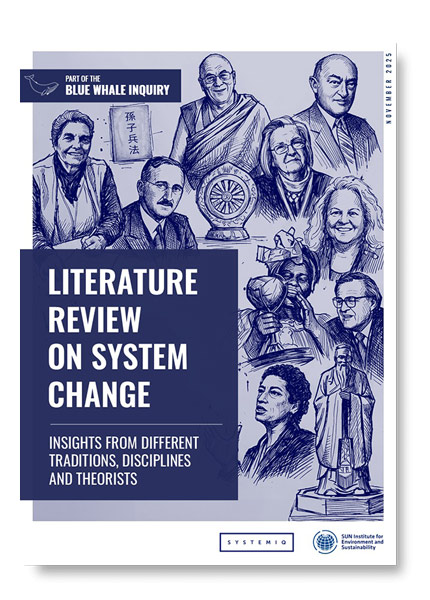
Literature Review on System Change
Insights from different traditions, disciplines and theorists
This literature review distils insights from more than 20 theorists, disciplines and traditions, from Confucian, Buddhist and Indigenous worldviews to Western complexity theorists. It demystifies the practices of system change – so that practitioners can engage more effectively with complex problems. And it turns theory into practical guidance for accelerating the transition to cleaner, fairer, and more prosperous economies.
PART OF THE BLUE WHALE INQUIRY
Holding the Tension
Reflections from NYCW 2025
In this note Jeremy Oppenheim shares five priorities from New York Climate week (NYCW). arguing that we need to combine purpose, principle and pragmatism in new ways.
PART OF THE BLUE WHALE INQUIRY
Lessons from the Field
How to change systems – from those who’ve done it
Lessons from the field spotlights stories and lessons from those on the frontline of change – spanning decades and continents – and captures success as well as failure. The result is a living archive of experience, hard-won lessons, and provocations from over 70 in-depth conversations with those who have worked, and continue to work, on system-scale challenges.
PART OF THE BLUE WHALE INQUIRY
Shock Therapy
A strategic reset for the sustainability movement
Nearly a decade after the Paris Agreement and the launch of the Sustainable Development Goals, progress on climate and nature is significant but fragile. The world has faced a series of shocks; from populist backlash and geopolitical fragmentation to pandemic upheaval, renewed conflict and economic uncertainty. How should the sustainability movement adapt? Shock Therapy sets out seven priorities for Sustainability’s reset.
*Why ‘Blue Whale’?
Before commercial whaling there may have been up to 350,000 blue whales in oceans around the world. During the 19th and 20th Centuries, they were decimated – reduced to just hundreds. Extinction loomed but thanks to a global campaign which spanned decades and brought together NGOs, scientists, governments and the sector, blue whales are now protected and their numbers are slowly recovering. We use them here as a symbol of collective action, perseverance, resilience and hope.