


Our biggest economic systems – the fossil fuel economy, intensive agriculture, single-use materials, short-term finance – all grew up to meet society’s needs. But they have run past their limits. We are now in the hardest phase of shifting to cleaner, fairer and more resilient alternatives.
A growing community of people around the world is working on that. Blue Whale exists to help them.
Blue Whale is an initiative jointly funded by Systemiq and the Sun Institute for Environment and Sustainability. We provide support and resources to practitioners working on economic system change.


The graphics below show how we think about shifting from old economic systems to new ones, based on our research and work. The first shows the four phases that new economic systems need to pass through before they can become dominant. The second shows how people can drive this process. Our publications and evidence are below.
The four phases of system change
PHASE ONE
Heresy
The alternative is demonstrated to be possible – and promptly dismissed. Incumbents treat it as marginal, naive, or threatening.
PHASE TWO
Early breakthrough
New value chains begin to form and scale. Costs fall, technology improves, and early coalitions emerge. What was heresy becomes demonstrably viable.
The question shifts from
can this work? to how fast can it grow?

PHASE THREE
Tipping Point
This is the hardest phase. Incumbents see an existential threat: as they approach peak demand for their products, business models and revenue, they resist strongly. Two systems run in parallel, each sub-optimal, each imposing costs. The critical barriers are no longer technical or financial, but political – vested interests and the challenge of declining the old system while accelerating the new. Shocks can change everything, quickly.
PHASE FOUR
Long Goodbye
The new system is dominant, but the old one takes decades to fully unwind – posing long-term risks that will require sustained collective action long after the outcome feels settled.
System change doesn’t happen in a straight line, or overnight. It is decades long and moves through phases – each with its own logic, obstacles, and demands on leadership. We have largely passed through phase 1 and 2 in energy, and are starting to move through them in food, materials, and finance systems.
How do we drive the transition from the old system to the new?
The three arts of system change

INSPIRE
Make the change plausible
and desirable
1 | Tell a compelling story
Mobilise the most important audiences with a credible and motivating vision
2 | Intersect with political priorities
Listen to and align with the issues at the top of the agenda
3 | Improve lives
Build support by delivering real, tangible benefits to people and places

OVERTAKE
Scale the new system so that it can outcompete the old and desirable
4 | Back the right breakthroughs
Scale innovations to tipping points
5 | Move enough money
Shift capital away from legacy systems and toward emerging ones
6 | Enable exit
Incumbent actors abandon the shrinking system

LEAD
Empower the leaders who can work together and get the job done
7 | Move together
Find ways for state, business and civil society actors to co-create living examples of the new system
8 | Persevere
Stay the course, understanding that system change is almost always decades-long
Publications
PART OF THE BLUE WHALE INQUIRY
Powering Through
Insights from the Ground Truth survey 2026
Ground Truth is the first annual survey to give the growing field of practitioners working on economic system change a voice on the big issues and dilemmas shaping our work. Its aim is to surface key barriers to transition – and to identify what is working well.
PART OF THE BLUE WHALE INQUIRY
The New Resource Economy
A vision for the role of boards in business resilience and economic transition
This report emerged from a shared hypothesis by Systemiq and Chapter Zero that the net zero framing has not always best served the strategic domain of the boardroom.
PART OF THE BLUE WHALE INQUIRY
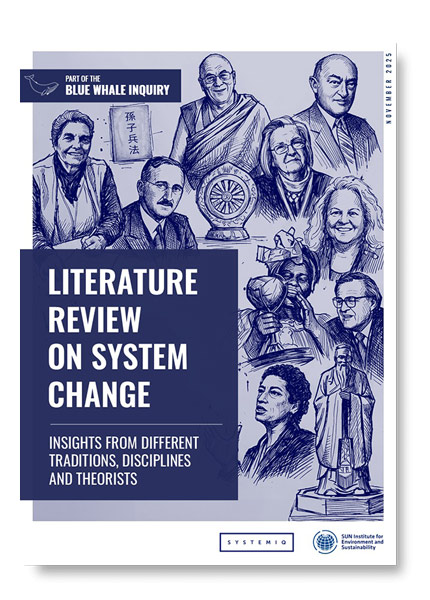
Literature Review on System Change
Insights from different traditions, disciplines and theorists
This literature review distils insights from more than 20 theorists, disciplines and traditions, from Confucian, Buddhist and Indigenous worldviews to Western complexity theorists. It demystifies the practices of system change – so that practitioners can engage more effectively with complex problems. And it turns theory into practical guidance for accelerating the transition to cleaner, fairer, and more prosperous economies.
PART OF THE BLUE WHALE INQUIRY
Holding the Tension
Reflections from NYCW 2025
In this note Jeremy Oppenheim shares five priorities from New York Climate week (NYCW). arguing that we need to combine purpose, principle and pragmatism in new ways.
PART OF THE BLUE WHALE INQUIRY
Lessons from the Field
How to change systems – from those who’ve done it
Lessons from the field spotlights stories and lessons from those on the frontline of change – spanning decades and continents – and captures success as well as failure. The result is a living archive of experience, hard-won lessons, and provocations from over 70 in-depth conversations with those who have worked, and continue to work, on system-scale challenges.
PART OF THE BLUE WHALE INQUIRY
Shock Therapy
A strategic reset for the sustainability movement
Nearly a decade after the Paris Agreement and the launch of the Sustainable Development Goals, progress on climate and nature is significant but fragile. The world has faced a series of shocks; from populist backlash and geopolitical fragmentation to pandemic upheaval, renewed conflict and economic uncertainty. How should the sustainability movement adapt? Shock Therapy sets out seven priorities for Sustainability’s reset.
*Why ‘Blue Whale’?
Before commercial whaling there may have been up to 350,000 blue whales in oceans around the world. During the 19th and 20th Centuries, they were decimated – reduced to just hundreds. Extinction loomed but thanks to a global campaign which spanned decades and brought together NGOs, scientists, governments and the sector, blue whales are now protected and their numbers are slowly recovering. We use them here as a symbol of collective action, perseverance, resilience and hope.