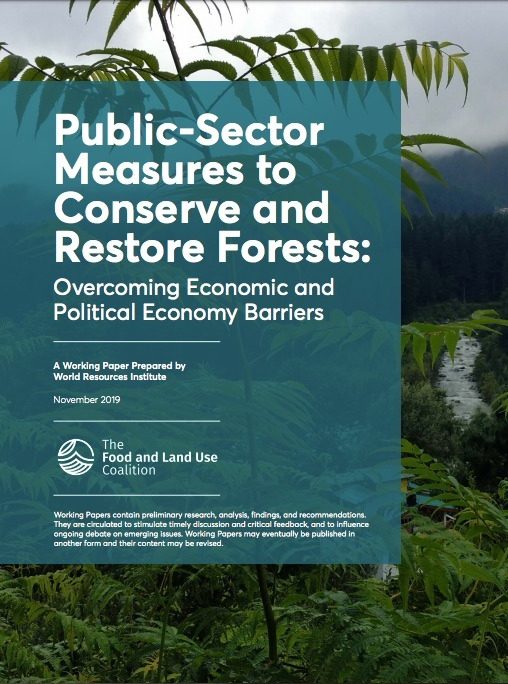
The world’s forests span nearly 4 billion hectares (FAO 2015). Forests provide a range of benefits, with approximately 1.6 billion rural people depending on them to some extent (Chao 2012). Billions more depend on forests for income and for global public goods such as rainfall and a stable climate.
Despite these benefits, the world’s forests continue to suffer from deforestation and degradation. Between 2001 and 2015, the world experienced about 314 million hectares (Mha) of tree cover loss. Large-scale commodity agriculture (e.g., palm oil, soy, beef) was the primary driver for about 25 percent of this, while smaller-scale agriculture appears to be the primary driver for about 21 percent. Wildfires (some natural, others human-caused) were the primary driver of 22 percent, clearing for forestry products was the primary driver for about 31 percent (but a lot of this could be replanted or allowed to regenerate), and urban expansion the primary driver of less than 1 percent (Curtis et al. 2018). In 2018 alone, tropical forest areas the size of Belgium were lost to agriculture, fire, logging, mining, and other pressures (Weisse and Goldman 2019)