
Europe stands at a crossroads: security is back on top of the agenda, climate impacts are intensifying, and competitiveness is under strain. These strategic ambitions are often treated as competing priorities, but in reality, they are interlinked and compounding threats. Yet they also share many overlapping opportunities. By approaching them together, Europe can identify many areas where the same solutions strengthen security, climate action, and competitiveness.
Systemiq, the University of Oxford ZERO Institute and Climate Change and (In)security Project, and the Clingendael Institute are launching two flagship publications.
The Resilience Agenda sets out seven strategic priorities for European leaders in a white paper.
The Resilience Nexus is the first comprehensive assessment of how security, climate and competitive interact in European context through an in-depth research paper.
The Resilience Agenda
White paper
The Resilience Agenda sets out forward-looking priorities for how Europe can strengthen security, climate action and competitiveness together. It translates the resilience nexus into seven key priorities that can guide policy, business and investment choices for more resilient outcomes:
- Expanded intelligence, foresight and analysis – anticipating security, climate and economic risks earlier, and understanding how shocks can cascade across systems before they become crises.
- Multi-mission innovation – Europe can break through if it turns innovation into a multiplier, developing technologies that strengthen defence, accelerate transitions and boost competitiveness together.
- Continental leverage – harnessing Europe’s scale by pooling demand, investment and capability across borders instead of fragmenting efforts along national lines.
- Financial mobilisation – treating spending on security, climate and infrastructure not as costs to minimise, but as investments in long-term resilience and prosperity.
- European leadership – enabling institutions to act more boldly and coherently, including through coalitions of the willing where needed, while respecting diversity and maintaining democratic legitimacy.
- Global outlook – reducing strategic dependencies while strengthening international partnerships that underpin a stable rules-based global order.
- Societal preparedness – putting people at the centre by building social cohesion, trust and readiness so societies themselves can withstand shocks.
Resilience Nexus
Research report
The threats Europe faces across security, climate and competitiveness are not isolated shocks but compounding disruptions. Climate impacts can trigger instability, displacement, and disruptions to production and trade, which in turn raise prices, widen fiscal stress, and amplify political fragility. Geopolitical conflict and coercion can disrupt energy, transport corridors, and supply chains, putting pressure on competitiveness. Russia’s manipulation of gas supplies and blockades of Black Sea ports translated into industrial disruption and higher costs across Europe. Lagging competitiveness erodes business capacity and public budgets to deal with climate and security threats and spending needs.
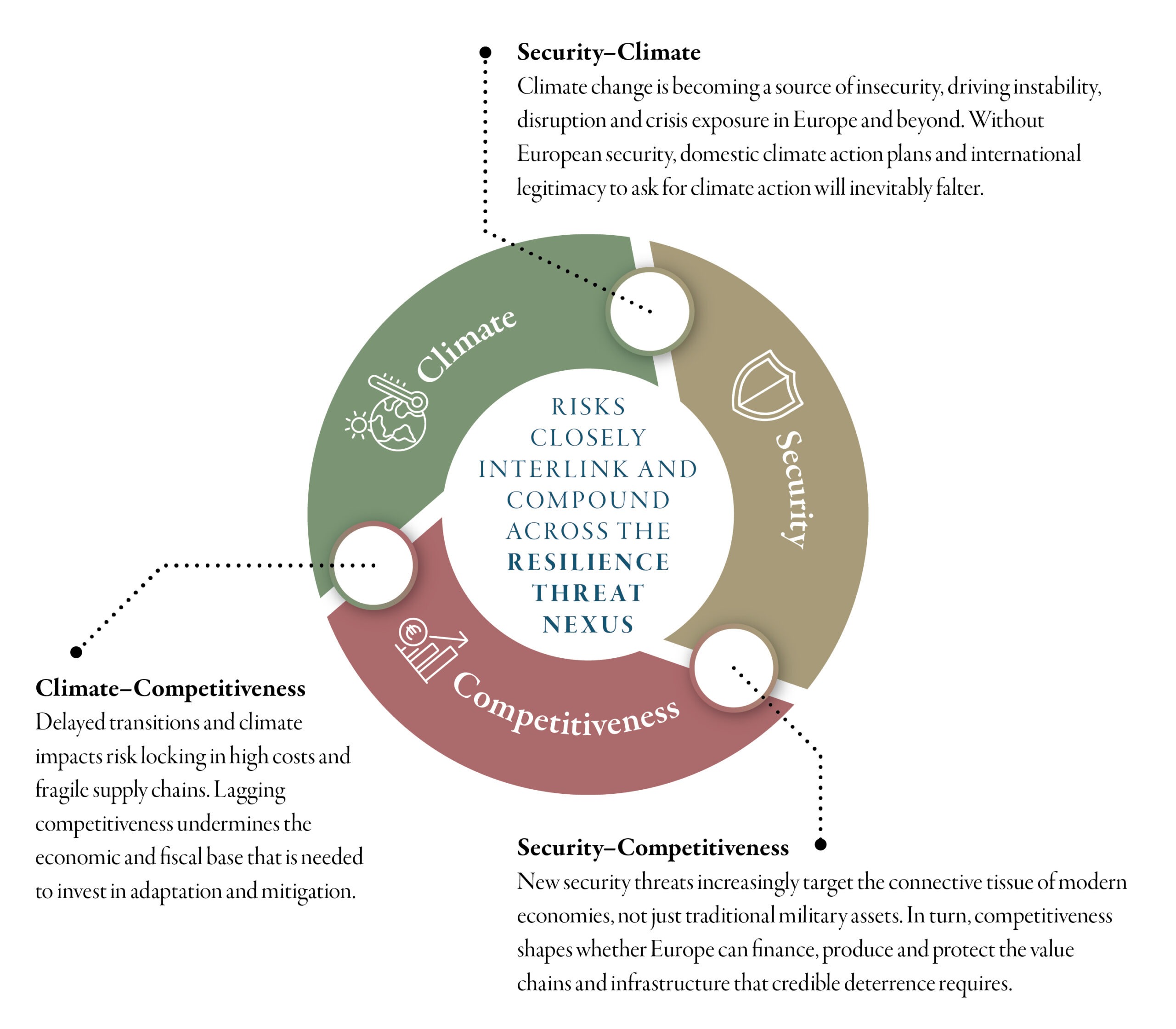
However, Europe could turn the resilience nexus into a strategic advantage with targeted actions that reduce vulnerability and create value. Many of the same capabilities, technologies, value chains and resources are critical to achieving security, climate and competitiveness. The highest value actions and policies are those that deliver dual or triple dividends across these domains, and can build knowledge, scale, credibility and deterrence, while maintaining economic openness. For example, cleantech value chains support economic security, while defence procurement can act as a lead customer to pay early premiums and catalyse cleantech innovation and cost reductions.
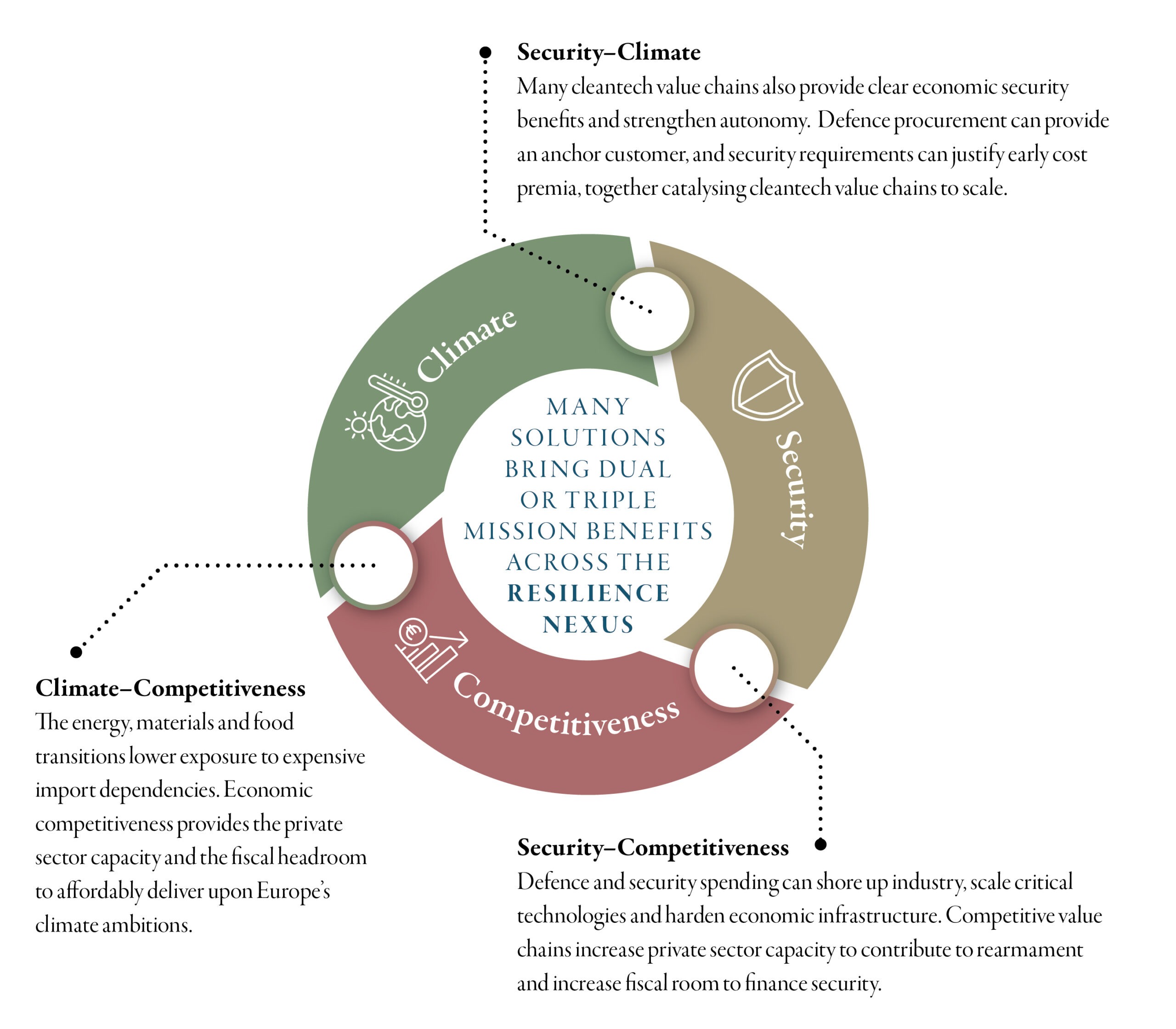
This paper unpacks three “security horizons” to operationalise the joint opportunities across security, competitiveness and climate:
- First horizon: Immediate readiness. Europe can better respond to military and climate threats by increasing military readiness, hardening infrastructure, strengthening disaster response and integrating stress-testing, underpinned by capabilities and technologies with dual use.
- Second horizon: Industrial defence base. Defence can act as a lead buyer to transform industry and bring broad innovation and productivity dividends through domains, including electrification, alternative fuels, materials science and circularity, digital technology, AI and satellites.
- Third horizon: Economic resilience. Europe can strengthen economic security and competitiveness by increasing resource productivity, deepening value chain integration, and building trade hedges in ways that reinforce security, climate and competitiveness goals.
”No level of defence spending can insulate us from resource import dependencies and climate-driven instability. Equally, a Europe that pursues climate goals without rebuilding industrial capability, energy security, and critical supply resilience will struggle to keep the transition affordable, durable, and politically defensible. The opportunity ahead is to design and invest in capabilities, value chains and economies that reinforce our shared ambitions across security, climate and competitiveness.
Baroness Kathy WillisPrincipal, St Edmund Hall & Professor of Biodiversity, University of Oxford & Crossbench Peer and Chair of Peers for the Planet, House of Lords.